Readers trust a finance newsletter partly because of what it says and partly because of how it looks. A briefing on interest rates set in a cheerful, bubbly blog theme feels wrong before anyone reads a word. A serious newspaper layout, with clean tables and a calm hierarchy, earns the reader's attention.
Ghost is a natural fit for money, markets, business and economics writers: it is a newsletter platform and a website in one, with paid tiers built in and no revenue cut. This guide covers what a finance newsletter needs from a Ghost theme, and how our theme, Ledger, delivers it.
What a finance newsletter needs
A look that signals seriousness
Newspaper typography, a proper masthead with the date, restrained colour and dense but orderly layouts. This is not decoration: it tells readers they are reading analysis, not marketing.
A daily or weekly briefing format
Most finance newsletters are briefings: five to ten items, each a short section. The format should make that structure obvious and easy to scan.
Tables that line up
Numbers are the content. Columns must align on the decimal point, use figures of equal width and read like a statement, not a spreadsheet pasted into a blog.
A place for the chart
Many finance writers anchor each issue with one chart. A homepage slot for "chart of the week" gives it the prominence it deserves.
Market context at a glance
A strip of key moves above the masthead (gold, oil, bonds, the local index) helps readers orient instantly.
A paid tier that feels premium
Finance readers will pay for good analysis. The membership page and paywall need to look like part of a serious publication.
How Ledger handles it
Ledger is a sharp, newspaper-style Ghost theme for finance, business and economics newsletters.
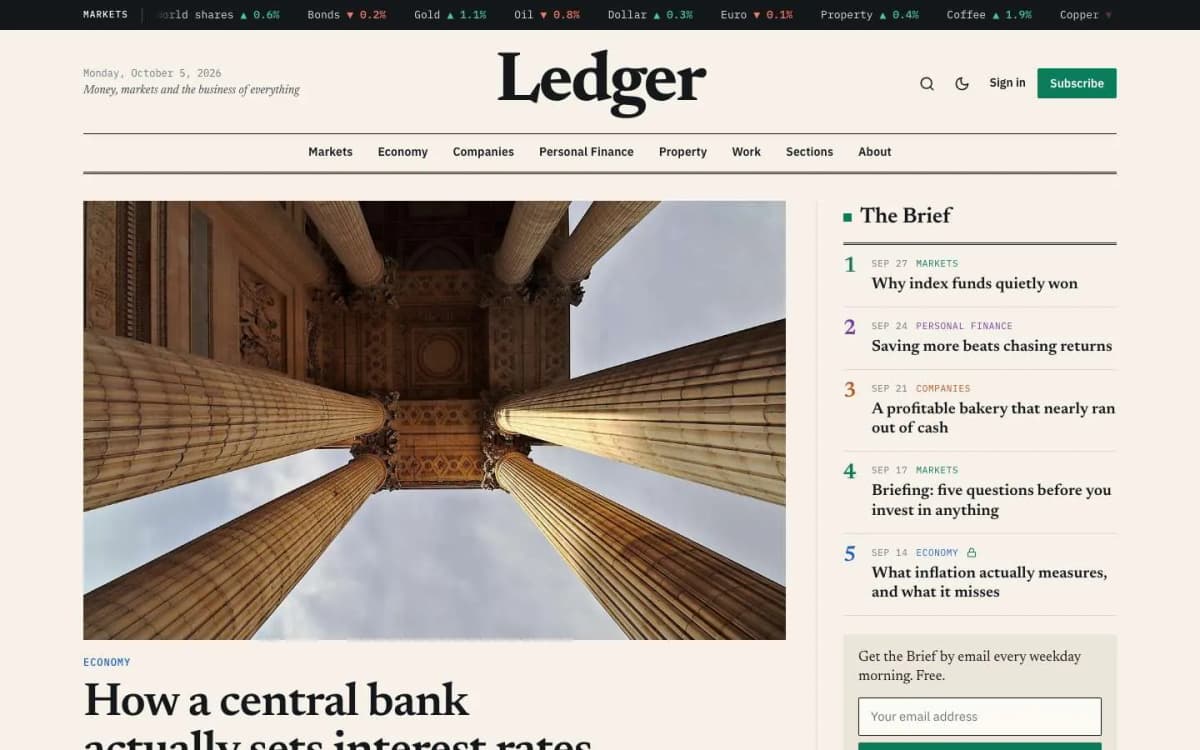
The ticker strip. A thin dark strip above the masthead scrolls slowly and pauses on hover. Type items like Gold +1.1% | Oil −0.8% | Bonds −0.2% in the theme settings: changes starting with + show in green with ▲, changes starting with − in red with ▼. Leave it empty and it shows your eight newest headlines instead. It stays still for readers who prefer reduced motion. It shows the text you type; it does not fetch live prices, so update it when you publish.
A classic masthead with the date and your tagline.
Front page. Your newest post as the lead story, beside a numbered "The Brief" column of the next five, with a signup box for visitors.
Chart of the week. The newest post with the internal tag #chart appears large on the homepage.
Section desks. Your four biggest tags each get a desk with a lead story and headlines, plus Editor's picks and a dense Latest list.
Serious reading. Serif text with a drop cap, and an "In this story" rail on wide screens that lists the post's headings and highlights the one you are reading.
Statement-style tables. Every column after the first is right-aligned in tabular figures, so numbers line up like a financial statement.
The Briefing template. For round-ups: no feature image, a Briefing bar with the day, and main sections numbered 01, 02, 03.
More in this section after every post, plus Sections and Reporters pages.
Memberships. A membership page with tiers and a monthly/yearly switch, a styled paywall, and sign-in, sign-up and account pages.
Details. Light first with dark and system modes; reading progress; image lightbox; self-hosted Newsreader, IBM Plex Sans and IBM Plex Mono fonts; full translation support; 18 theme settings; no jQuery.
Read a briefing on the Ledger live demo.
What Ledger does not do
- No live market data. The ticker is your text or your headlines. If you need live quotes, embed a widget from a data provider in your posts.
- No interactive charts. Charts are images you upload (or embeds from a charting tool). Ledger gives them a prominent place; it does not draw them.
- Not playful. If your brand is loud and personal, Riot is a better fit.
Building a finance newsletter on Ghost
- Pick one format and stick to it. A morning brief, a weekly deep-dive or both. Use the Briefing template for the brief.
- Use four sections at most to start. Markets, Companies, Economy, Personal finance. They become the section desks.
- Tag your chart posts with #chart. It keeps the homepage fresh with no extra work.
- Write tables as tables. Not screenshots. They are searchable, accessible and look right on phones.
- Keep the free issue valuable. Paid readers come from free readers who trust you. Lock the deeper analysis, models or the archive.
- Mind the rules. Depending on your country, giving investment advice may be regulated. Add clear disclaimers and take advice if you are unsure.
Our guide to Ghost paid memberships with Stripe covers tiers, trials and offers in detail.
Other themes to consider
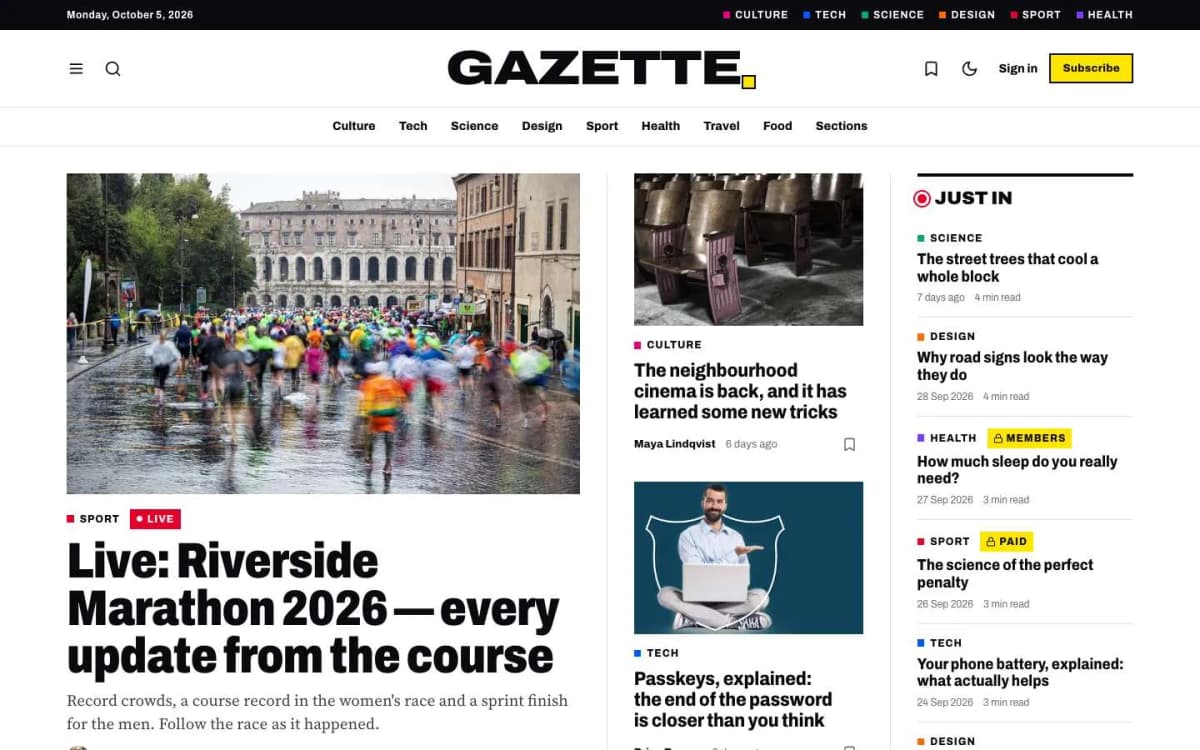
- Gazette: for general news across several sections, with a live blog for market-moving events.
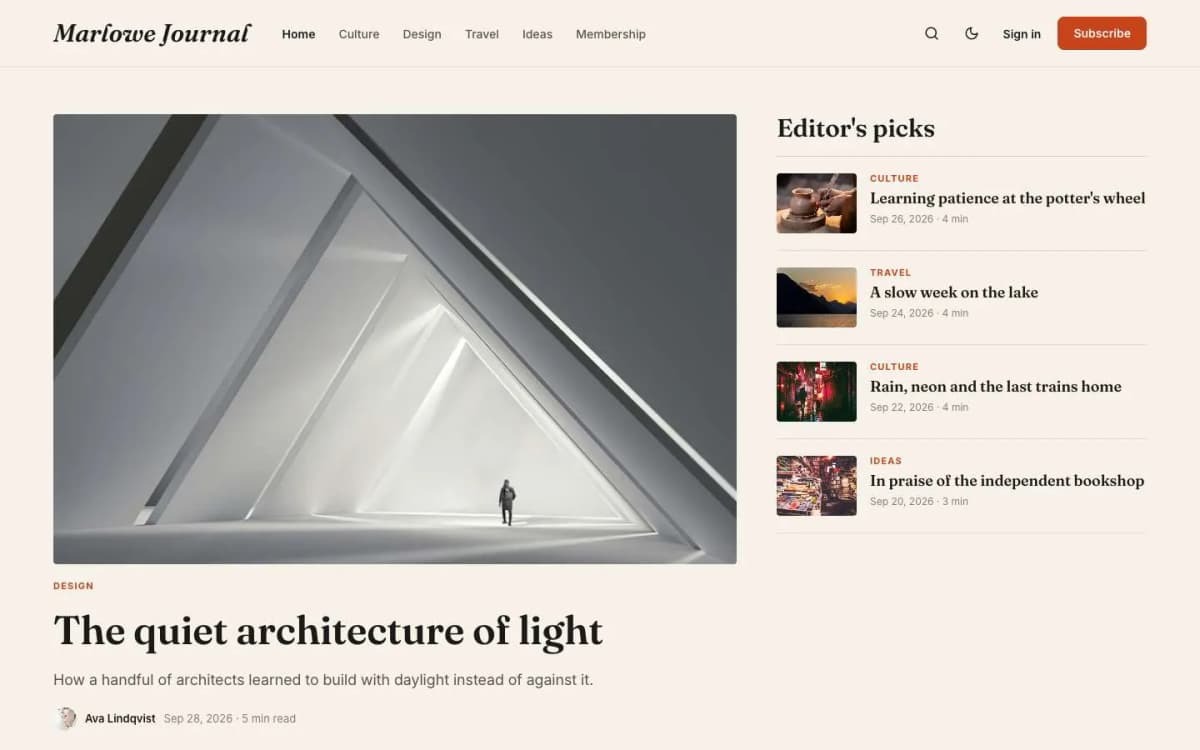
- Marlowe: for long-form business essays in a warmer, editorial style.
- Compare them all on our Ghost themes page.
Staying on the right side of the rules
Finance writing carries responsibilities that other niches do not. This is not legal advice, and rules differ by country, but a few habits are common sense for any finance publisher:
- Separate information from advice. Explaining how something works is different from telling a reader what to buy. If you are not licensed to give personal advice where your readers live, say clearly that you do not.
- Add a short disclaimer to your footer or about page, and link it from paid issues.
- Disclose your positions when you write about something you own, and disclose any payment or affiliate link.
- Date everything. Markets move. A clear publish date on every issue, and a note when an older piece is out of date, protects readers and your reputation.
- Cite your sources for numbers and charts, and link to the original data where you can.
A sample weekly structure
A structure that works for many finance newsletters, and suits a briefing layout:
- The headline: one sentence on the most important thing that happened this week.
- Three things to know: short items, each with a number and why it matters.
- The chart: one chart, explained in a paragraph.
- The deep dive: a longer section for paid members, analysing one topic properly.
- The calendar: what to watch next week.
Free readers get the first three sections; paid members get the deep dive and the calendar. That split keeps the free issue genuinely useful while giving a clear reason to upgrade.
Charts that survive email
Charts are central to finance writing and fragile in email. Export charts as images at a sensible size, with large labels that are readable on a phone. Avoid colours that are hard to tell apart, and add the key number in the text as well, because some email apps block images until the reader allows them.
Corrections
When you get a number wrong, correct it quickly and openly: fix the post on your site with a dated correction note, and mention it in the next issue. Finance readers forgive mistakes that are owned, and a visible corrections habit is one of the clearest signs of a serious publication.
Bottom line
A finance newsletter needs to look as careful as its analysis. Ledger gives you a newspaper masthead, a ticker strip, The Brief, a chart of the week, statement-style tables, a briefing template and paid memberships, for $59, without a market data subscription you do not need.
See it in action: open the Ledger demo and get Ledger. Want it set up with your sections, ticker and tiers? Our Ghost theme install and setup service handles it.
Frequently asked questions
No. Ledger's ticker shows text you type, such as Gold +1.1% | Oil −0.8%, with green and red arrows, or your latest headlines. It does not fetch live prices, so there is no data feed to pay for and nothing that goes stale silently.
Add an HTML card with a normal table and a header row. Ledger right-aligns every column after the first in tabular figures, so numbers line up like a financial statement.
A post layout for daily or weekly round-ups. It hides the feature image, adds a Briefing bar with the day and numbers each main section 01, 02, 03.
Yes. Ghost has paid memberships through Stripe and sends posts as emails. Remember that financial content may be regulated where you live; this is a publishing tool, not compliance advice.